
Door Access Control Installation in City of Industry, CA
City of Industry · ZIP 91744, 91746, 91748 · San Gabriel Valley · Access Control Systems
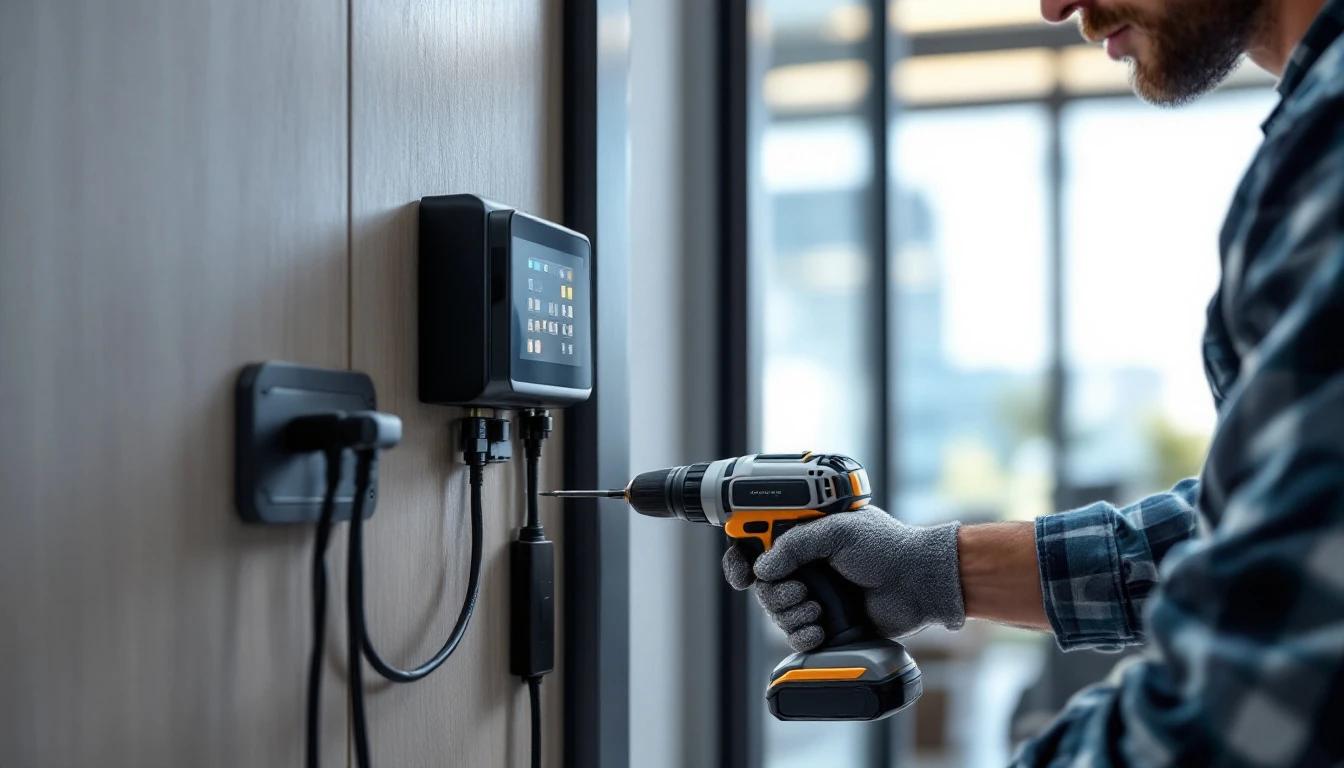
When you need door access control installation in City of Industry, you need a licensed low-voltage contractor who arrives with the proper hardware on the truck — not a lead broker that farms out your job to whoever answers. Los Angeles Access Control installs, programs and maintains entry systems all over City of Industry and the surrounding communities, and each project is handled by in-house techs, start to finish.
Quotes cost nothing, you approve a written number before any work starts, and labor and parts are warrantied. Call (888) 917-9811 — we're available Sunday–Thursday 6:30 AM–11:30 PM and Friday 6:30 AM–4 PM.
Local door access control installation experts serving City of Industry
Dispatching City of Industry daily means we quote accurately the first time. Properties near Gale Avenue often mix decades of legacy wiring with newer tenant improvements, and our techs carry the interface modules, power supplies and retrofit brackets that those jobs demand. Being minutes off the I-605, emergency calls in 91744 are reached quickly.
Beyond City of Industry, the very same technicians serves La Puente, Hacienda Heights, West Puente Valley and Valinda, so businesses with several locations enjoy a single point of contact across every site: (888) 917-9811.
The technology behind the system
Our bench covers the industry's main platforms: HID readers and credentials, Brivo and Avigilon Alta (Openpath) cloud access control, DoorKing and ButterflyMX entry systems, Axis door controllers, and professional locking hardware from the names inspectors recognize. Brand choice follows your building's needs, never to a sales quota.
On the wire side, we're moving customers from Wiegand to OSDP — an encrypted, supervised protocol that closes Wiegand's known holes. Most modern readers support it already; ask us whether your wiring qualifies.
Typical applications
Warehouses — where we tailor traffic patterns, user counts and liability exposure, down to schedules and alert rules.
Medical offices — where the system is tuned to traffic patterns, user counts and liability exposure, down to schedules and alert rules.
Office suites — one of our most frequent project types, with reference sites we're happy to describe.
Apartment common areas — a property type we've equipped many times across LA County, with reference sites we're happy to describe.
Don't see your property type? We've likely done it — from marinas to machine shops. Describe it at (888) 917-9811 and we'll talk through options.
Our process, step by step
1. Site survey. One of our techs surveys the property with you, noting door and frame construction, existing wiring, power availability and network paths. You get an itemized proposal — not a guess.
2. Engineering. We pair hardware for each opening, calculate power budgets, plan controller and network locations, and confirm fire and egress code compliance up front.
3. Installation. Our crew — never day labor — run cabling cleanly, mount hardware square and solid, and work around your business hours so your operation never stops.
4. Programming. Credentials are enrolled, time zones and holidays programmed, alerts configured, and integrations (video, intercom, elevator) connected.
5. Testing and training. Every credential is tested at every relevant door, and your administrators are trained hands-on — with documentation left on site and on file with us.
6. Ongoing support. We keep your as-builts, programming records and parts list on file, so future service calls are fast. Preventive maintenance plans are offered without lock-in contracts.
What cheap installs get wrong
Phone-only quotes. Either the price balloons mid-job or corners get cut. Insist on a walkthrough — ours are free.
Leftover legacy credentials. An upgrade that keeps the old database keeps the old holes. A credential audit belongs in every takeover.
Undersized power. Behind most "haunted" systems is a starved power supply — good power is cheap insurance.
No documentation. When the installer vanishes, undocumented systems become hostage situations. Documentation should be a deliverable, not a favor.
Security that traps people. A maglock without compliant release mechanisms is a violation and a liability. Compliance has to be in the design, not patched after.
When to make the call
Something went missing and the entry log is a shrug — an event history would have answered it in minutes.
Your existing system is down more than it's up — past a point, stabilizing legacy hardware costs more than replacing it.
Each departure means another rekey bill — electronic credentials turn that into a ten-second software change.
An auditor wants access records you don't have — documented access control is becoming table stakes in many industries.
Nobody can say how many keys exist for your doors — each one is standing access you can't revoke.
One of these alone is reason enough to call; stacking several means the risk is live. A phone consult costs nothing: (888) 917-9811.
Search terms that lead here — and why
The same need wears many labels: owners type "wireless door access control installation" while others try "door access control installation", others look for "access control system setup" or "door access control installation near me". Each phrase points at the same job — who does this properly in City of Industry and answers the phone afterward — and the answer is the same local team: Los Angeles Access Control, (888) 917-9811.
Related work we handle under the same roof spans IP access control installation, electronic access control installation, access control site survey, wired access control installation and building access control installation. Bundling related scopes into one visit beats hiring for them one at a time — one truck roll, one survey, one accountable vendor.
Why City of Industry calls us first
Warrantied workmanship. Labor and manufacturer warranties on everything we install, honored without arguments.
Written, flat quotes. The number you approve is the number you pay. No surprise line items.
Non-proprietary by default. Open standards mean you own your system — and our service keeps you with us by choice, not contract.
One trade, deep focus. Entry systems are our entire business — not a sideline bolted onto an alarm company.
Long hours, real answers. Open Sunday–Thursday 6:30 AM–11:30 PM and Friday to 4 PM. Entry failures don't respect business hours, so neither do we.
A real local company. Headquartered at 189 The Grove Drive in Los Angeles, with techs living and working across the county. Service calls get a truck, not a ticket number.
Comparing your options
Single-door standalone systems work for one or two doors with simple needs: self-contained hardware with onboard programming. The trade-off is management — every change means a walk to the door, and reporting is thin.
Server-based systems centralize control in a local panel or server: rich features, deep integrations, no subscriptions, at the cost of maintaining the server and software yourself. Best for larger single sites with IT support.
Cloud-managed systems now dominate new installs: manage every door from a browser, updates arrive automatically, and multi-site portfolios live in one dashboard. You pay a subscription, and for most owners it replaces costs they were already paying in service calls.
Not sure where you land? That's what the free survey answers — we'll recommend the cheapest option that actually solves your problem, and put the reasoning in writing. (888) 917-9811.
The security details that separate good installs from bad ones
Weak points get found: a hardened entry next to an unmonitored side door is a diagram of where the loss will happen. Part of every survey is walking the whole perimeter, so spend lands where risk actually lives.
The log is half the value: door held open alarms, forced-door events, repeated denied attempts reach the right person in real time, instead of being discovered in a log after the loss. Alert tuning is included in every install.
Budgeting for door access control installation
Truthfully, it depends on the opening count and conditions — but it's knowable fast. Cost is driven by: number of doors or gates, what each door is made of, how far and how hard the cable runs are, credential technology, and the locking hardware each opening needs.
As rough orientation: a single-door standalone system is the economy entry point; multi-door networked systems add per-door cost with shared head-end; cloud platforms shift spend toward subscription; and gate and intercom work is quoted per device and distance. Your exact number comes from a free survey — schedule at (888) 917-9811.
Code compliance, egress and safety
An installer who doesn't ask about your fire alarm panel is a red flag. Maglocks in particular carry strict egress requirements: sensor release, auxiliary push buttons, fire-alarm disconnects and time delays under state code. Our installations pass inspection because they're designed for inspection — and we pull permits where required.
Documentation is part of compliance: as-built drawings, door schedules, release mechanisms and test records are delivered and kept on file, so fire marshals, insurers and future contractors get answers in minutes.
What usually goes wrong (and how we fix it)
After-hours access with no record. The right hardware and programming make this a non-issue — usually faster than owners expect.
Keys that can't be tracked or revoked. We see this constantly — and the repair includes the reason it failed.
Rekeying costs after staff turnover. We see this constantly — and our fix addresses the root cause, not the symptom.
No audit trail of who entered. This one comes up weekly — so the repair includes the reason it failed.
These calls rarely wait well: an unsecured door invites loss, and a stuck one blocks business. Fast scheduling are usually available at (888) 917-9811.
Scheduling, emergencies and follow-through
Entry failures rarely pick convenient moments, so our dispatch hours are long — Sunday–Thursday 6:30 AM to 11:30 PM and Friday to 4 PM — and same-day slots are held for genuine emergencies: a storefront that won't lock, a gate stuck open, a lobby door trapping deliveries. Tell the dispatcher the symptom and you'll get an honest triage — not everything needs an emergency rate, and we'll say so.
Follow-through is where contractors are measured: we schedule warranty work with the same urgency as paid work, and the file we keep on your system means nobody re-learns your building on your dime.
Coverage details: ZIP codes, corridors and surrounding areas
Our City of Industry service area covers all of ZIP codes 91744, 91746 and 91748 — including the areas near the Puente Hills business parks to the Industry logistics corridor, out to Gale Avenue. Commercial corridors, residential streets and industrial pockets alike get the same response standard, reached via the SR-60 and I-605.
Just outside City of Industry, the nearest communities we serve include La Puente, Hacienda Heights, West Puente Valley, Valinda and Avocado Heights. Routes frequently chain these areas together, which is part of why response here stays fast.
What our door access control installation service includes
We handle it all — credential readers and request-to-exit sensors, through door controllers and backup power supplies. Since a single crew owns the electrical, mechanical and software layers, nothing falls between vendors.
The company installs and services open, non-proprietary platforms wherever possible, so your building is never hostage to a single manufacturer for future parts and service. If you already own a closed system, we take over, stabilize and migrate it on your schedule.
Terms you'll hear during the project
Credential — the thing you present: fob, badge, code, smartphone or biometric. Encryption level varies wildly between credential generations.
OSDP — an encrypted, supervised successor to Wiegand that resists skimming and tamper.
Door position switch (DPS) — a sensor reporting whether the door is physically open or closed, enabling held-open and forced-door alarms.
Anti-passback — a rule preventing a credential from entering twice without exiting, common in garages and secured floors.
Access level — the bundle of doors and schedules a credential is allowed. Most messy systems are really access-level design failures.
Request-to-exit (REX) — hardware that detects someone leaving and releases the lock so exit never requires a credential.
Door Access Control Installation in City of Industry: FAQs
Can the system lock and unlock doors on a schedule?
Yes — schedules are standard: front doors can unlock for business hours and secure themselves at close, including holidays and special dates. No more "who forgot to lock up".
What happens to my system if your company weren't around?
We invite that question: because we install non-proprietary platforms and hand you documentation plus admin credentials mean any qualified integrator could take over. We earn retention through service, not hostage-taking.
Can I get temporary access for vendors, cleaners or contractors?
Easily: a cleaning crew gets specific doors, specific hours, auto-expiring, with every entry logged. The master-key-on-a-hook era ends.
Do you give free estimates?
Yes — site surveys and quotes are free and carry no obligation. You receive a written scope with real hardware and a fixed price up front.
What areas do you serve?
All of Los Angeles County — from the San Fernando Valley to the South Bay, the Westside to the San Gabriel Valley, with daily routes through City of Industry. One quick call confirms coverage: (888) 917-9811.
Are you licensed and insured?
Absolutely. Los Angeles Access Control is a licensed, insured low-voltage contractor performing work throughout Los Angeles County, including permitted work where your city requires it.
Will the doors still open if the power goes out?
Yes — by design. Exiting is always possible: hardware is selected per code so people can always exit, and battery-backed power rides through typical outages. Power-loss behavior is part of our commissioning checklist.
Do you offer maintenance plans?
Yes — preventive visits covering batteries, firmware, testing and documentation, on terms you can cancel. No plan is ever required — our work holds up either way.
Is door access control installation disruptive to my business while it's installed?
Rarely. Openings are kept functional during the day, and we schedule disruptive steps off-hours, and clean up every day. Occupied buildings are our normal condition.
Do you work on occupied buildings without disrupting tenants?
Constantly — it's our normal condition. We stage the work so entries keep functioning and coordinate notice with your manager.
How fast can you schedule door access control installation in City of Industry?
The majority of repairs get same- or next-day slots, and installs usually start within the week. Phones are answered Sunday–Thursday 6:30 AM–11:30 PM and Friday to 4 PM at (888) 917-9811.
Can you service a system another company installed?
Usually, yes. We regularly take over systems whose installer disappeared — stabilizing them, recovering admin access and bringing documentation up to date so you're no longer dependent on whoever vanished.
What happens when an employee or tenant leaves?
Their credential is deactivated in seconds — without touching a single lock. For most owners this alone justifies the switch from keys.
Can I manage the system from my phone?
With cloud-based platforms, yes: remote unlock, credential changes and real-time alerts from any browser or the mobile app. Ask for a demo at your survey.
Do you handle both installation and ongoing service?
Yes — that's central to how we work. Your as-builts, programming records and parts list stay in our file, which makes every future visit faster.
More Access Control Systems in City of Industry
Door Access Control Installation in nearby cities
Explore
Book door access control installation in City of Industry
Licensed, insured and local. Fast scheduling across Los Angeles County — written quotes, warrantied work.
Call (888) 917-9811Sun–Thu 6:30 AM–11:30 PM · Fri 6:30 AM–4 PM