
Magnetic Lock Installation in El Monte, CA
El Monte · ZIP 91731, 91732, 91733 · San Gabriel Valley · Magnetic Locks & Electric Strikes
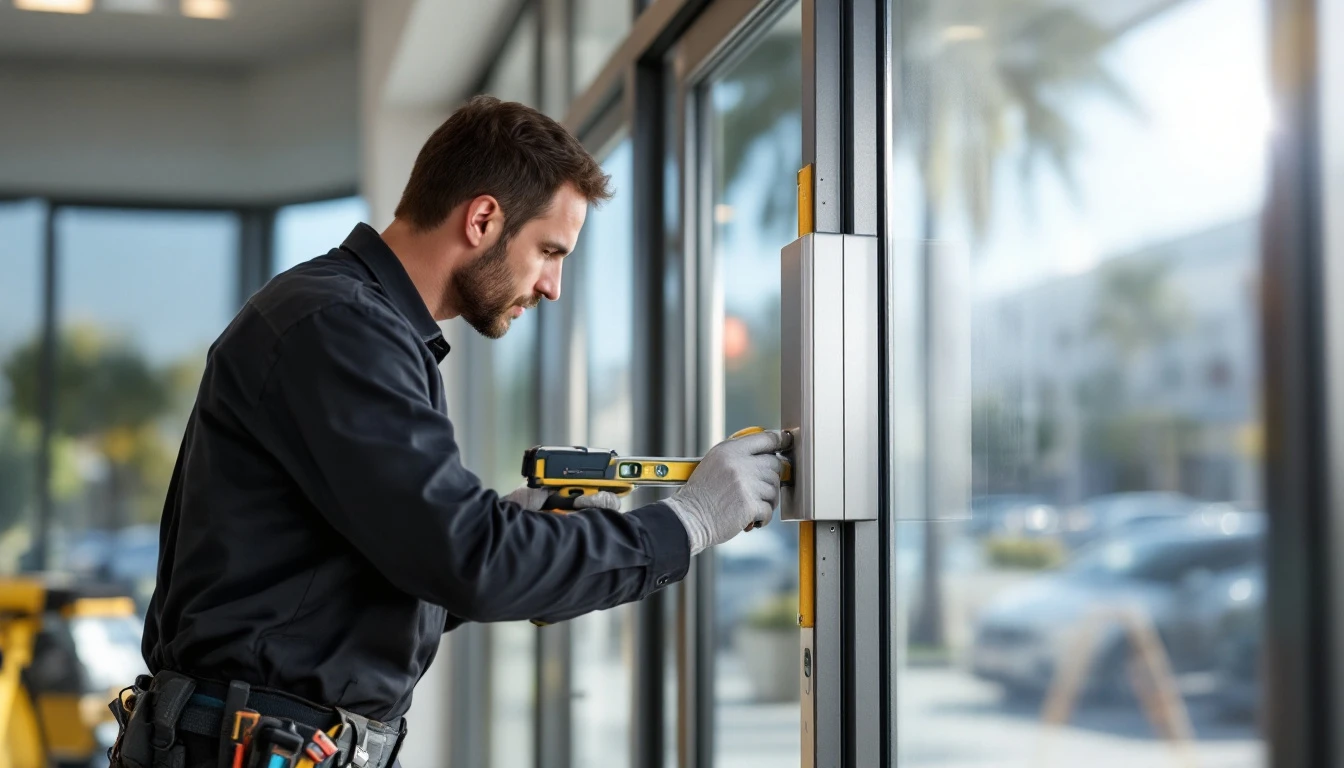
Los Angeles Access Control provides professional magnetic lock installation to offices, buildings and homes in El Monte. From the first site walk to the final walkthrough, our own technicians own the whole project — wiring, hardware, software and training included.
Reach us today at (888) 917-9811 to get a no-obligation site assessment. We answer seven days' worth of long hours — 6:30 AM to 11:30 PM Sunday–Thursday, Fridays to 4 PM, which means a real person handles your call, not a phone tree.
Magnetic lock installation built for El Monte
El Monte sits in the San Gabriel Valley, and we know it street by street. Whether your property is near the El Monte bus station district or Santa Anita Avenue, or anywhere along the I-605, we arrive with local knowledge of the building stock common to the 91731 area — aluminum storefronts, wood-frame offices, stucco multifamily walk-ups and tilt-up industrial shells — which means fewer surprises and faster installs.
In addition to El Monte, the very same team covers South El Monte, Avocado Heights, Rosemead and Temple City, which means multi-site owners enjoy a single point of contact across every site: (888) 917-9811.
Key terms, plainly explained
Door position switch (DPS) — a sensor reporting whether the door is physically open or closed, the basis for propped-door and forced-entry alerts.
OSDP — the modern, encrypted reader protocol replacing legacy Wiegand wiring closing known attack paths on the reader wire.
Request-to-exit (REX) — the sensor or button that releases a locked door from inside so exit never requires a credential.
Access level — the bundle of doors and schedules a credential is allowed. Most messy systems are really access-level design failures.
Anti-passback — logic that stops one fob from being passed back to admit a second person, used in parking and high-security zones.
Credential — the thing you present: fob, badge, code, smartphone or biometric. Modern encrypted credentials resist the cloning that plagues older prox cards.
Built to code — fire, egress and ADA
Locking a door electrically touches fire code, building code and ADA at once. California's Building Code and Fire Code dictate how locked egress doors must release: free mechanical egress, fail-safe unlocking on fire alarm, request-to-exit coverage and proper signage where applicable. We design every opening around those rules first — because people always come before property.
Documentation is part of compliance: riser diagrams and test logs are delivered and kept on file, which keeps inspections and insurance reviews painless.
What to expect when you hire us
1. Assessment. We evaluate every door, gate and opening in scope, noting door and frame construction, existing wiring, power availability and network paths. This produces an itemized scope and quote — with real model numbers.
2. System design. We pair hardware for each opening, size power supplies with battery backup, map panel locations, and confirm fire and egress code compliance before anything is ordered.
3. Installation. Our own employees — not subcontractors — run cabling cleanly, fit hardware precisely, and keep the site workable with minimal disruption.
4. Programming. Users, schedules and access levels are configured, auto-lock and unlock schedules set, alerts configured, and any integrations brought online.
5. Testing and training. Each opening is tested under power loss, egress and forced-entry conditions, and your administrators are trained hands-on — with documentation left on site and on file with us.
6. Service after the sale. Your system's documentation lives in our service records, which means any tech we send already knows your site. Preventive maintenance plans are offered but never required.
Magnetic lock installation: what we install and service
Every installation covers the full stack of equipment: Z and L brackets for inswing doors, armature plates and brackets, glass door U-brackets, plus request-to-exit devices. We don't leave loose ends — wiring is labeled, as-builts are delivered, and administrators are trained at handoff.
Every entry point receives components chosen for its actual door and frame: locking devices selected around life-safety code, readers rated for the environment, and supervised power with backup batteries. Skipping that engineering is why bargain installs fail early — ours are built to run for a decade.
Comparing your options
Standalone hardware is the entry point: right for very small scopes, though it leaves you without real records or remote control.
Networked on-premise systems put every door on one brain: rich features, deep integrations, no subscriptions, at the cost of maintaining the server and software yourself. Best for larger single sites with IT support.
Cloud systems have become our most-requested configuration: remote unlock, instant credential changes and automatic updates with no server to babysit. You pay a subscription, which typically costs less than the maintenance it eliminates.
Not sure where you land? That's what the free survey answers — we'll recommend the cheapest option that actually solves your problem, with reasoning you can hold us to. (888) 917-9811.
One service, many names: what people search for
People describe this work a dozen different ways: owners type "magnetic door lock" while others try "electromagnetic door lock installation", property managers tend toward "magnetic lock and buzzer system installation" and "magnetic lock exit button installation". They're all asking the same question — who can design, install and stand behind this in El Monte — and the answer is the same local team: Los Angeles Access Control, (888) 917-9811.
Questions that ride along with this one often involve magnetic lock installation cost, commercial magnetic lock installation, storefront magnetic lock installation, maglock system and maglock installation. Raise them at the survey — the combined quote is usually the bargain.
Why El Monte calls us first
Hours that match emergencies. Open Sunday–Thursday 6:30 AM–11:30 PM and Friday to 4 PM. Entry failures don't respect business hours, so neither do we.
A real local company. Based at 189 The Grove Drive in Los Angeles, with techs living and working across the county. When something needs attention, we're minutes away — not a ticket queue in another state.
Non-proprietary by default. We install open-platform systems you could have anyone service — and our service keeps you with us by choice, not contract.
Transparent pricing. Prices are quoted in writing before work starts. Change orders only happen when you change the scope.
Backed work. Every installation carries labor and parts warranties, honored without arguments.
One trade, deep focus. Entry systems are our entire business — not a sideline bolted onto an alarm company.
What "secure" actually requires
Attackers go around strong points, not through them: a hardened entry next to an unmonitored side door is a diagram of where the loss will happen. Our surveys look at the building the way an intruder would, so spend lands where risk actually lives.
The log is half the value: held-open alerts, forced entries, credential misuse patterns reach the right person in real time, instead of being discovered in a log after the loss. We configure alerting as part of commissioning, not as an upsell.
How to know you need this now
Repairs on the old system are becoming routine — the repair-versus-replace math eventually flips.
Each departure means another rekey bill — electronic credentials turn that into a ten-second software change.
Nobody can say how many keys exist for your doors — each one is standing access you can't revoke.
Something went missing and the entry log is a shrug — audit trails are the first thing investigators and insurers ask for.
Doors get propped because entry is inconvenient — convenience failures become security failures.
One of these alone is reason enough to call; stacking several means the risk is live. A phone consult costs nothing: (888) 917-9811.
Understanding the investment
Truthfully, price follows scope — and we can pin it down quickly. Cost is driven by: how many openings, what each door is made of, wiring distance and pathway difficulty, reader and credential choice, and whether locking hardware must be added or replaced.
For general orientation: a single-door standalone system is the economy entry point; networked multi-door systems scale per opening; cloud platforms shift spend toward subscription; and gate and intercom work is quoted per device and distance. A free site survey produces an exact written quote — book at (888) 917-9811.
The technology behind the system
Not all credentials are equal: legacy 125 kHz prox cards can be cloned at a mall kiosk, while 13.56 MHz smart credentials and mobile credentials use encryption. We'll tell you plainly which you have and what it would take to upgrade.
Behind the walls, we're moving customers from Wiegand to OSDP — supervised, encrypted reader communication that resists skimming and cut-wire attacks. Most modern readers support it already; we verify compatibility during the survey.
Where magnetic lock installation makes the biggest difference
Pedestrian gates — where the system is tuned to the way the space is actually used, down to schedules and alert rules.
Frameless glass entries — a property type we've equipped many times across LA County, with proven hardware packages ready to quote.
Office suites — where the system is tuned to the way the space is actually used, from credential policy to door schedules.
Aluminum storefront doors — for which the system is tuned to the way the space is actually used, down to schedules and alert rules.
Running something different? Odds are we've equipped one like it — from marinas to machine shops. Call (888) 917-9811 and we'll talk through options.
Scheduling, emergencies and follow-through
Door and gate failures ignore business hours, so our dispatch hours are long — Sunday–Thursday 6:30 AM to 11:30 PM and Friday to 4 PM — with same-day capacity reserved for urgent calls: failed storefront locks, stuck gates, dead lobby entries. Describe the symptom when you call and you'll get an honest triage — not everything needs an emergency rate, and we'll say so.
The job doesn't end at the invoice: as-builts and programming records stay in our system, so the next request — a new door, a credential batch, a tenant change — starts warm.
Exactly where we work in and around El Monte
Dispatches in El Monte span ZIP codes 91731, 91732 and 91733, taking in Valley Mall and the El Monte bus station district as well as Santa Anita Avenue. Positioned in the San Gabriel Valley, with the I-10 nearby, response windows here are among our best.
Just outside El Monte, we're equally active in South El Monte, Avocado Heights, Rosemead, Temple City and West Puente Valley. Scheduling often pairs jobs across neighboring cities, which is part of why response here stays fast.
Avoid these common missteps
Phone-only quotes. Either the price balloons mid-job or corners get cut. Insist on a walkthrough — we do them free.
Proprietary lock-in. Some vendors install hardware only they can service. Always ask: "who else can work on this?"
Undocumented installs. When the installer vanishes, undocumented systems become hostage situations. Documentation should be a deliverable, not a favor.
Old cards left active. An upgrade that keeps the old database keeps the old holes. We audit and purge on every system takeover.
Ignoring egress code. A maglock without compliant release mechanisms is a violation and a liability. Verify your installer designs for inspection.
What usually goes wrong (and how we fix it)
Code-compliant egress on locked doors. The right hardware and programming make this a non-issue — often within one scheduled visit.
Doors that can't take a strike cutout. This one comes up weekly — so the repair includes the reason it failed.
High-traffic doors wearing out mechanical locks. It's among our most common calls — and we correct the underlying design, not just the broken part.
Frameless glass entries needing locking. This one comes up weekly — and the repair includes the reason it failed.
Recognize one of these? Call (888) 917-9811 and describe the symptom — many issues are identified before we even arrive, which keeps the visit short and the invoice small.
Magnetic Lock Installation in El Monte: FAQs
What if my building already has old wiring from a previous system?
Often good news: we test and reuse healthy legacy wiring, which meaningfully reduces install cost. The survey includes testing what's in the walls — only what fails gets replaced.
What happens to my system if your company weren't around?
A fair question for any vendor: open platforms, delivered documentation and your own admin access mean any qualified integrator could take over. We earn retention through service, not hostage-taking.
Can I manage the system from my phone?
With cloud-based platforms, yes: unlock doors remotely, grant visitor access, review events and get alerts from any browser or the mobile app. Ask for a demo at your survey.
How long does an installation take?
A single door is typically done in a day. Larger systems scale with door count and wiring difficulty — the timeline is part of your written proposal, and we keep to it.
Is financing or phased installation available for larger projects?
Phasing is routine: start with high-risk openings and expand by phase, engineered up front so each phase extends, not reworks.
Do you give free estimates?
Yes — estimates cost nothing and you're never pressured. The quote lists actual equipment and a locked price before any work begins.
Will the doors still open if the power goes out?
Yes, that's engineered in. Egress is always free: hardware is selected per code so people can always exit, and battery-backed power rides through typical outages. We test exactly this during commissioning.
Do you work on occupied buildings without disrupting tenants?
Yes, most of our work is in occupied buildings. Doors stay usable during the day, noisy work is scheduled considerately, and tenants get notice through management.
Do you offer maintenance plans?
Yes — scheduled inspections, battery replacement, firmware updates and priority response, on terms you can cancel. No plan is ever required — the install is built to last regardless.
Is magnetic lock installation disruptive to my business while it's installed?
Rarely. Openings are kept functional during the day, and we schedule disruptive steps off-hours, and clean up every day. Occupied buildings are our normal condition.
How fast can you schedule magnetic lock installation in El Monte?
The majority of service calls get same- or next-day slots, and installs usually start within the week. We answer Sunday–Thursday 6:30 AM–11:30 PM and Friday to 4 PM at (888) 917-9811.
Are you licensed and insured?
Yes. Los Angeles Access Control is a licensed, insured low-voltage contractor performing work throughout Los Angeles County, including permitted work where your city requires it.
Can you service a system another company installed?
In most cases, yes. We regularly take over orphaned and legacy systems — stabilizing them, recovering admin access and bringing documentation up to date so you're never stranded again.
What happens when an employee or tenant leaves?
Their credential is deactivated in seconds — without touching a single lock. For most owners this alone justifies the switch from keys.
Do you handle both installation and ongoing service?
Yes — that's central to how we work. Your as-builts, programming records and parts list stay in our file, so every later call is faster and cheaper.
More Magnetic Locks & Electric Strikes in El Monte
Magnetic Lock Installation in nearby cities
Explore
Book magnetic lock installation in El Monte
Licensed, insured and local. Fast scheduling across Los Angeles County — written quotes, warrantied work.
Call (888) 917-9811Sun–Thu 6:30 AM–11:30 PM · Fri 6:30 AM–4 PM