
Medical Office Access Control in Sunland, CA
Sunland · ZIP 91040 · San Fernando Valley · Industry Solutions
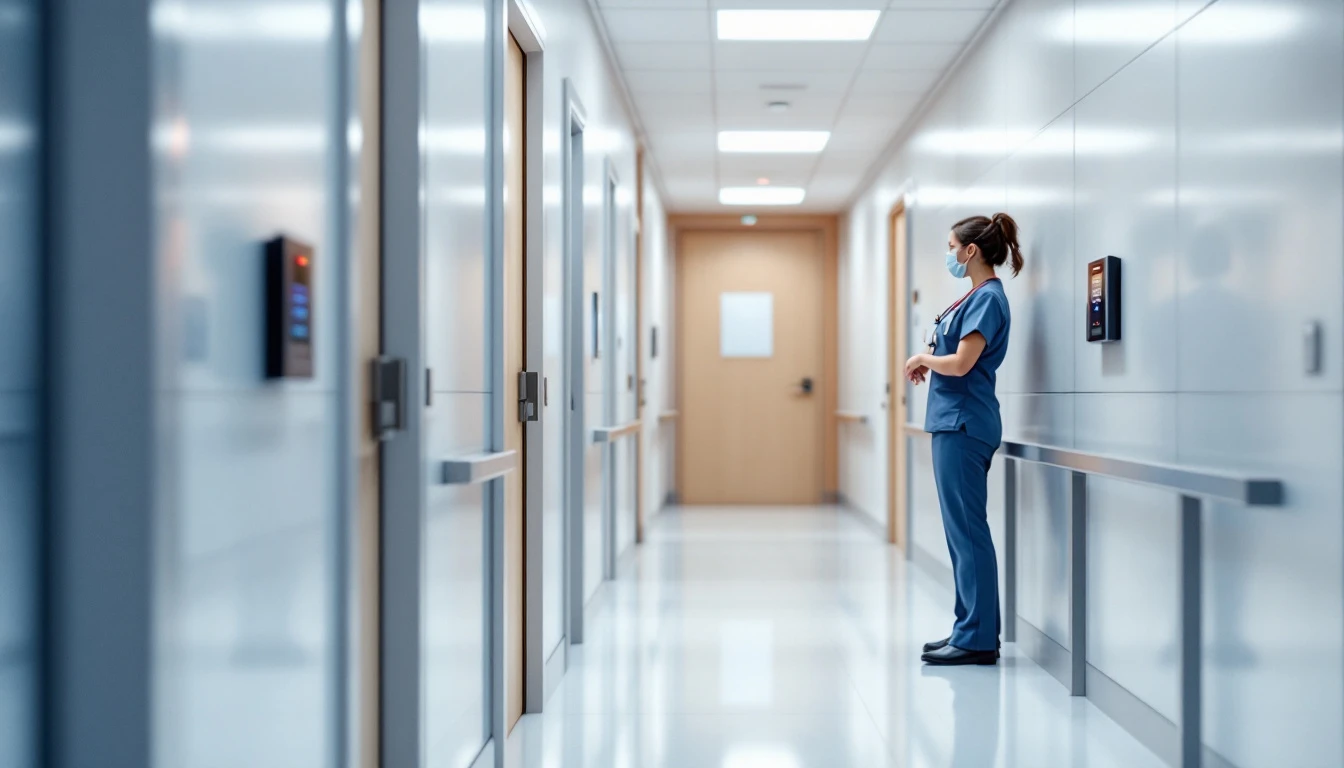
If you need medical office access control in Sunland, you need a licensed low-voltage contractor who shows up with the proper hardware on the truck — not a national call center that resells your job to an unknown subcontractor. Los Angeles Access Control installs, programs and maintains entry systems all over Sunland and the surrounding communities, and each project is handled by our employed technicians, start to finish.
Estimates are free, pricing is put in writing before work begins, and labor and parts are warrantied. Call (888) 917-9811 — open Sunday–Thursday 6:30 AM–11:30 PM and Friday 6:30 AM–4 PM.
Medical office access control built for Sunland
Dispatching Sunland daily means we've already solved your building type before. Properties near Foothill Boulevard often mix decades of legacy wiring with newer tenant improvements, and our techs stock the interface modules, power supplies and retrofit brackets that those jobs demand. Being minutes off the I-210, emergency calls in 91040 are reached quickly.
Alongside Sunland, the very same team covers Tujunga, Shadow Hills, La Crescenta-Montrose and Lake View Terrace, so multi-site owners enjoy one vendor, one standard, one phone number: (888) 917-9811.
The technology behind the system
Not all credentials are equal: legacy 125 kHz prox cards can be cloned at a mall kiosk, while modern smart cards and phone credentials are encrypted. We'll tell you plainly which you have and what it would take to upgrade.
Most system failures trace to power: cheap power supplies and neglected batteries cause the majority of mystery faults. Every system we install gets properly sized, battery-backed, supervised power — and every service plan includes battery testing.
The compliance layer most installers skip
An installer who doesn't ask about your fire alarm panel is a red flag. Electromagnetic locks especially are tightly regulated: sensor release, auxiliary push buttons, fire-alarm disconnects and time delays under state code. We design to pass inspection the first time — and we pull permits where required.
Accessibility is part of it: reader mounting heights, operating force, auto-operator coordination and clear floor space all factor into where and how devices mount. Designed-in compliance is free; fixing it after a citation is not.
How a medical office access control project works
1. Walkthrough. A technician walks every door, gate and opening in scope, documenting door and frame construction, existing wiring, power availability and network paths. You get an itemized scope and quote — not a guess.
2. Design. We pair hardware for each opening, calculate power budgets, map panel locations, and verify life-safety compliance before anything is ordered.
3. Installation. In-house technicians — never day labor — pull and label every cable, fit hardware precisely, and keep the site workable with minimal disruption.
4. Configuration. Users, schedules and access levels are configured, time zones and holidays programmed, alerts configured, and integrations (video, intercom, elevator) connected.
5. Commissioning. Each opening is tested under power loss, egress and forced-entry conditions, and whoever manages the system gets real training — with documentation left on site and on file with us.
6. Ongoing support. Your system's documentation lives in our service records, so future service calls are fast. Maintenance plans are available but never required.
What our medical office access control service includes
We handle it all — audit reporting to records room locks, through after-hours provider access and staff-only zones. Since one team owns hardware, low-voltage wiring and software alike, nothing falls between vendors.
Every opening gets hardware matched to its construction: fail-safe or fail-secure locking chosen per egress requirements, weather- and vandal-rated readers where needed, and power sized with headroom for battery backup. Skipping that engineering is why bargain installs fail early — ours are built to run for a decade.
Jargon decoded
Anti-passback — logic that stops one fob from being passed back to admit a second person, common in garages and secured floors.
Request-to-exit (REX) — the sensor or button that releases a locked door from inside so egress is always free.
OSDP — the modern, encrypted reader protocol replacing legacy Wiegand wiring that resists skimming and tamper.
Credential — whatever unlocks the door: card, fob, PIN, phone or fingerprint. Modern encrypted credentials resist the cloning that plagues older prox cards.
Fail-safe vs. fail-secure — what a lock does when power drops: fail-safe unlocks (maglocks), fail-secure stays locked (typical for perimeter security). Each opening gets the right one per code and risk.
Access level — the bundle of doors and schedules a credential is allowed. Good access-level design is the difference between a tidy system and chaos.
One service, many names: what people search for
However you got here — searching "medical office access control", "clinic access control systems", "dental office access control" or something close — the service behind the words is identical: a licensed technician, the right hardware, and a system commissioned to code in Sunland.
Related work we handle under the same roof includes . Combining these in a single project beats hiring for them one at a time — one truck roll, one survey, one accountable vendor.
Why Los Angeles Access Control
Backed work. Every installation carries labor and parts warranties, honored fast.
Local and accountable. Based at 189 The Grove Drive in Los Angeles, serving every corner of LA County daily. When something needs attention, we're minutes away — not a ticket queue in another state.
Long hours, real answers. Available Sunday–Thursday 6:30 AM–11:30 PM and Friday to 4 PM. Entry failures don't respect business hours, so neither do we.
Transparent pricing. The number you approve is the number you pay. No surprise line items.
Specialists, not generalists. Access control, intercoms, buzzers, maglocks and gate entry are all we do — not a sideline bolted onto an alarm company.
No vendor lock-in. Open standards mean you own your system — though most customers never want anyone else.
Typical applications
Medical offices — a property type we've equipped many times across LA County, with proven hardware packages ready to quote.
Veterinary hospitals — for which we tailor traffic patterns, user counts and liability exposure, down to schedules and alert rules.
Clinics — one of our most frequent project types, with reference sites we're happy to describe.
Pharmacies — for which the system is tuned to traffic patterns, user counts and liability exposure, down to schedules and alert rules.
Running something different? Odds are we've equipped one like it — from houses of worship to film stages. Call (888) 917-9811 for a straight answer.
Mistakes to avoid when buying medical office access control
No documentation. No as-builts means the next tech starts blind. Demand as-builts and admin credentials in writing.
Closed systems. Certain platforms handcuff you to one company forever. Always ask: "who else can work on this?"
Pricing without a site visit. Either the price balloons mid-job or corners get cut. A real survey protects you — we do them free.
Cheap power supplies. Behind most "haunted" systems is a starved power supply — good power is cheap insurance.
Ignoring egress code. A maglock without compliant release mechanisms is a violation and a liability. Verify your installer designs for inspection.
Understanding the investment
No two buildings price alike since wire paths, frame types and panel locations differ. Which is why our quotes come from an actual site survey — so the figure you approve is the figure you pay.
As rough orientation: a single-door standalone system is the economy entry point; networked multi-door systems scale per opening; cloud platforms shift spend toward subscription; and gate and intercom work is quoted per device and distance. Your exact number comes from a free survey — book at (888) 917-9811.
Signs it's time for medical office access control
Each departure means another rekey bill — electronic credentials turn that into a ten-second software change.
An auditor wants access records you don't have — controlled, logged entry is increasingly a requirement, not a luxury.
Doors get propped because entry is inconvenient — convenience failures become security failures.
An incident happened and there's no record of who came in — an event history would have answered it in minutes.
Your existing system is down more than it's up — past a point, stabilizing legacy hardware costs more than replacing it.
Any one of these justifies a conversation; stacking several means the risk is live. A phone consult costs nothing: (888) 917-9811.
Choosing the right approach to medical office access control
Standalone systems fit small scopes: a coded lock or single-door controller, no network, minimal cost. The trade-off is management — every change means a walk to the door, and reporting is thin.
On-premise panels remain the right call where subscriptions are unwelcome or the network can't reach the cloud — we install plenty of them — but they demand someone who owns backups and updates.
Cloud systems have become our most-requested configuration: remote unlock, instant credential changes and automatic updates with no server to babysit. The subscription is the trade, which typically costs less than the maintenance it eliminates.
Unsure which fits? That's what the free survey answers — our recommendation is the least system that fully solves the problem, with reasoning you can hold us to. (888) 917-9811.
How fast can we get there?
Entry failures rarely pick convenient moments, which is why we answer — Sunday–Thursday 6:30 AM to 11:30 PM and Friday to 4 PM — with same-day capacity reserved for urgent calls: failed storefront locks, stuck gates, dead lobby entries. Describe the symptom when you call and you'll get an honest triage — if it can safely wait for a standard slot, we'll tell you.
The job doesn't end at the invoice: as-builts and programming records stay in our system, so the next request — a new door, a credential batch, a tenant change — starts warm.
Local coverage, spelled out
Jobs here run across ZIP code 91040, taking in Foothill Boulevard and Sunland Park. As part of our San Fernando Valley routes, minutes from the I-210, response windows here are among our best.
The same medical office access control service extends to: Tujunga, Shadow Hills, La Crescenta-Montrose, Lake View Terrace and Burbank. Multi-property owners across these cities typically put everything under one account — a single point of contact: (888) 917-9811.
Hardening details most installers skip
A reader on the wall isn't security by itself. What decides it: is the lock's wiring exposed on the unsecured side? will a propped door raise an alarm? can the cards be cloned at a kiosk? Is the controller on battery backup? Our installs answer all of these by design.
Think about failure modes before they happen: power loss, dead internet, alarm activation — each scenario has a designed response, and we test them before handoff, not during the real thing.
Problems we solve every week
Patients wandering into staff areas. We see this constantly — and our fix addresses the root cause, not the symptom.
Controlled substances storage compliance. A properly engineered system eliminates this entirely — usually in a single service visit.
Records rooms on one metal key. It's among our most common calls — so our fix addresses the root cause, not the symptom.
Audit requests with no data. A properly engineered system eliminates this entirely — usually faster than owners expect.
Left alone, these issues get costlier: an unsecured door invites loss, and a stuck one blocks business. Fast scheduling is the norm at (888) 917-9811.
Medical Office Access Control in Sunland: FAQs
Is financing or phased installation available for larger projects?
We phase large projects all the time: secure the critical doors first, add the rest on your budget's schedule, engineered up front so each phase extends, not reworks.
What brands do you install?
Professional, non-proprietary lines including HID, Brivo, Avigilon Alta (Openpath), DoorKing, ButterflyMX and Axis, with commercial-grade locking hardware throughout. The building's needs pick the brand.
How long does an installation take?
A single door is typically done in a day. Larger systems scale with door count and wiring difficulty — the timeline is part of your written proposal, and we keep to it.
What if my building already has old wiring from a previous system?
Usually that helps: sound existing cable can frequently be reused, which meaningfully reduces install cost. The survey includes testing what's in the walls — reuse what passes, replace what doesn't.
Will the doors still open if the power goes out?
Yes — by design. Egress is always free: fail-safe hardware unlocks on power loss where code requires, and battery backup keeps systems running through outages. We test exactly this during commissioning.
Is medical office access control disruptive to my business while it's installed?
Rarely. Openings are kept functional during the day, schedule noisy or door-down phases around your hours, and clean up every day. Most of our work happens in occupied, operating buildings.
What happens when an employee or tenant leaves?
You deactivate the fob, card or phone credential instantly — without touching a single lock. For most owners this alone justifies the switch from keys.
What areas do you serve?
The whole of Los Angeles County — every region, from Lancaster to Long Beach, including Sunland. If you're unsure, call: (888) 917-9811.
How fast can you schedule medical office access control in Sunland?
The majority of service calls are scheduled same-day or next-day, and installs usually start within the week. We answer Sunday–Thursday 6:30 AM–11:30 PM and Friday to 4 PM at (888) 917-9811.
Do you offer maintenance plans?
Yes — preventive visits covering batteries, firmware, testing and documentation, without long lock-in contracts. Plans are optional — our work holds up either way.
Do you give free estimates?
Yes — site surveys and quotes are free and carry no obligation. The quote lists actual equipment and a locked price up front.
Are you licensed and insured?
Yes. Los Angeles Access Control operates as a licensed and insured contractor performing work across Los Angeles County, including permitted work where your city requires it.
Can you service a system another company installed?
In most cases, yes. We take over systems whose installer disappeared — identifying the hardware, recovering or resetting programming, and documenting everything properly so you're never stranded again.
Can I manage the system from my phone?
On modern cloud systems, absolutely: remote unlock, credential changes and real-time alerts from any browser or the mobile app. Ask for a demo at your survey.
Do you handle both installation and ongoing service?
Yes — that's central to how we work. Your as-builts, programming records and parts list stay in our file, so every later call is faster and cheaper.
Can you integrate with cameras, alarms or my property software?
In most cases, yes — video, intrusion, elevator and PMS integrations are routine for us. Bring your current system list to the survey and we'll map what connects.
Can the system lock and unlock doors on a schedule?
Yes — schedules are standard: front doors can unlock for business hours and secure themselves at close, with holiday calendars and exception dates handled automatically. The "did anyone lock up?" question disappears.
Do you work on occupied buildings without disrupting tenants?
Constantly — it's our normal condition. Doors stay usable during the day, noisy work is scheduled considerately, and tenants get notice through management.
More Industry Solutions in Sunland
Medical Office Access Control in nearby cities
Explore
Book medical office access control in Sunland
Licensed, insured and local. Fast scheduling across Los Angeles County — written quotes, warrantied work.
Call (888) 917-9811Sun–Thu 6:30 AM–11:30 PM · Fri 6:30 AM–4 PM